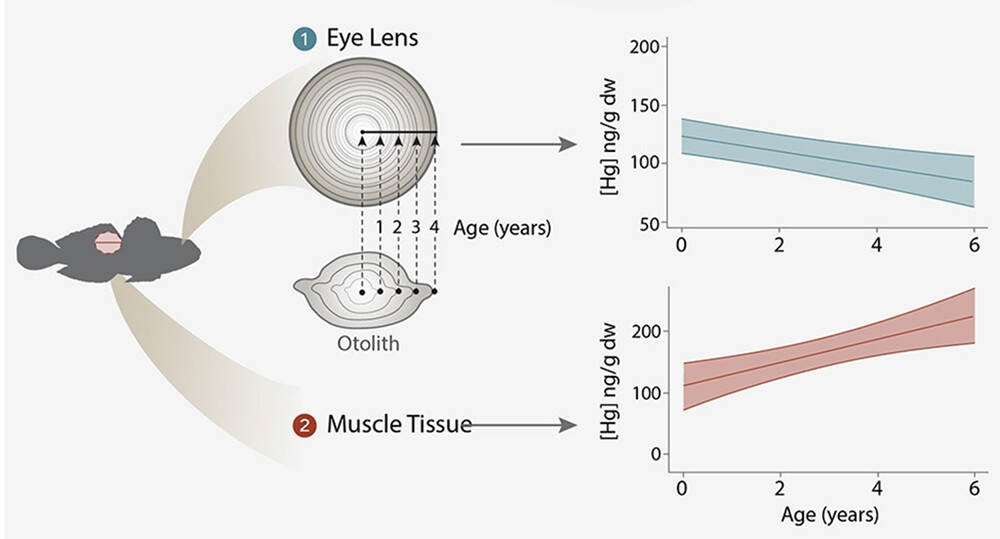
This project investigates how mercury (Hg) uptake in fish varies through time and across ecosystems by using an innovative tissue-based approach. While conventional assessments of Hg exposure rely on muscle or whole-body analyses that integrate lifetime bioaccumulation, our study focuses on reconstructing the temporal dynamics of Hg uptake within individual fish.
To achieve this, we use the eye lens as a chronological archive of exposure, allowing us to trace Hg accumulation on an annual scale. The study focuses on the benthic round goby (Neogobius melanostomus), a widely distributed species collected from the Baltic Sea, Lake Erie, and the St. Lawrence River. Eye lenses are aged by establishing proportional relationships between otolith length at age and eye lens radius for each individual, providing a detailed timeline of growth and exposure. Mercury concentrations are then quantified using laser ablation inductively coupled plasma mass spectrometry (LA-ICP-MS).
By combining microchemical analysis with growth-based aging, this project aims to deepen our understanding of the environmental and biological factors—such as diet, growth rate, and local productivity—that shape mercury bioaccumulation in aquatic ecosystems.